Tank Systems for Fish Farming: Types, Materials, and How to Choose What You Need
Tank systems for fish farming range from simple above-ground swimming pools used for tilapia production in backyards to sophisticated fiberglass or concrete circular tanks in commercial recirculating operations producing hundreds of thousands of pounds of fish annually. Understanding the functional requirements of your production system — species, stocking density, aeration needs, drainage requirements, light exposure, and budget — is the basis for making tank selection decisions that serve your operation rather than creating limitations you will try to work around.
Circular vs. Rectangular Tank Design
Circular tanks are the industry standard for recirculating aquaculture systems because their geometry produces self-cleaning flow dynamics when water is introduced tangentially — the circular current pushes settled solids to the center drain, from which they are continuously removed, maintaining cleaner water conditions with less mechanical intervention than rectangular tanks. Circular tanks also provide more uniform water velocity throughout the tank volume, ensuring all fish have access to oxygenated water and reducing areas of stagnation where disease organisms can concentrate.
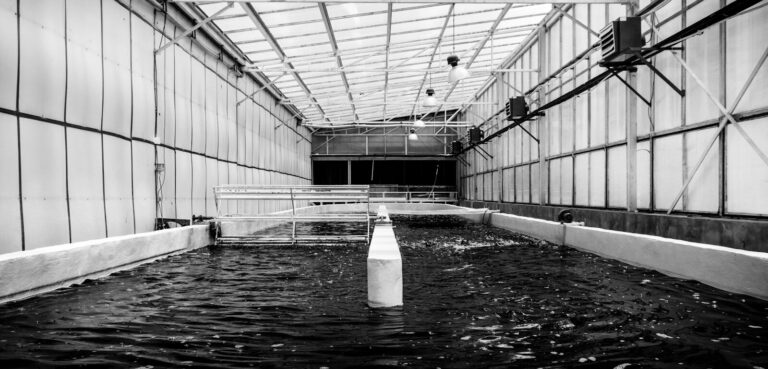
Rectangular tanks are simpler to construct in concrete or wood-frame construction for pond-side nursery applications and flow-through systems where continuous fresh water maintains water quality without the active solid removal that recirculating systems require. They are standard in trout raceways and are appropriate for outdoor or greenhouse grow-out operations where recirculation is not the primary water management strategy.
Tank Materials
Fiberglass tanks — available from aquaculture supply manufacturers in standard sizes from 100 to 5,000 gallons — are the most commonly used material for commercial recirculating systems. They are durable, smooth-surfaced for easy cleaning, food-safe, and available in round configurations with center drains. Initial cost is higher than polyethylene tanks but longevity and performance justify the investment for commercial applications. High-density polyethylene (HDPE) tanks — the blue or black oval tanks familiar from livestock and agricultural supply stores — are less expensive and appropriate for smaller-scale operations or experimental systems. Concrete tanks offer permanent, custom-configured infrastructure at high initial cost but decades of service life in intensive production environments.
Aeration and Flow Configuration
Tank system aeration must be designed for the maximum stocking density the system will carry, not the starting density. Low-pressure air diffusers, submerged aeration, and surface agitation through tangential water inflow all contribute to dissolved oxygen maintenance. In recirculating systems with high stocking densities, pure oxygen injection from liquid oxygen or oxygen concentrators may be required to maintain adequate DO levels that air aeration alone cannot achieve. Design the oxygen system for your target maximum stocking density and size it with margin — oxygen depletion in a high-density recirculating system can produce significant mortality within hours of system failure.